

Experiment 001
Experiment 001 was a 10-day immersive container where we looked at what it takes to live together. It was based on the premise that oftentimes, even with the best intentions, we replicate the same systems that we are wishing to disrupt. Whether it’s fear and control-driven mindsets, unbalanced power dynamics, our relationship to the environment, etc., we seem stuck. This observation led to a desire to explore what occurs when we actively try to sense and work with these thought patterns in new ways. The hypothesis being that by sensing ourselves and our communities we could influence the way we are able to be, interrelate, and create.
Methodology
Over the course of 10 days, we worked across multiple levels of awareness. Starting with sensing our inner worlds and how they create our perception of reality. We then moved to the group level and looked at how we collaborated, communicated, and what roles we played.
Finally, we sensed a larger whole in which we were embedded. We set the Traditional Dream Factory, the host, and a regenerative community project as our system bounds. We sensed what was the unique potential of the place and worked with the owners to help them align with that energy. At each level, we uncovered awarenesses that we would then carry over to and build on in the next level.
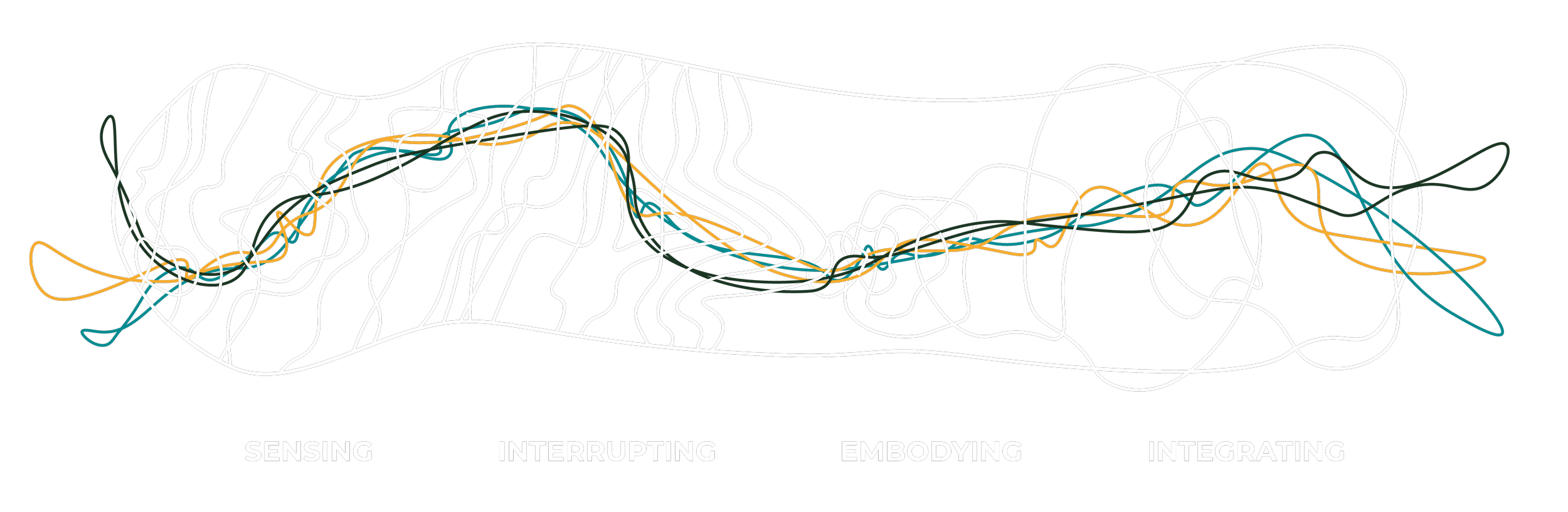
As we moved across levels of awareness, we followed the same flow as follows:
Sensing:
We learned from living and collaborating together. We used our thoughts patterns body sensations, and observation to sense what is alive in ourselves and in the system. We learned to be guided by this rather than question it.
Interrupting :
We introduced tools to allow us to analyze and question our perceptions of reality. We brought in speakers from across the globe who had unique perspectives on that level of experience; we spoke with a Buddhist monk when experiencing our inner worlds, and learned non-violent communication practices when navigating group dynamics.
Embodying:
We developed ritualized practices that helped us embody the most vitalized form of ourselves and the system. This ranged from personal meditation practices to communal space holding. We also identified, accepted, and owned our roles within the group. By doing so the focus shifted to the wellbeing of the community.
Integrating:
We practiced daily integration through movement, journaling, time in nature, and shared reflection. After each level, we dove deeper into what we’d discovered to help us make sense of what the patterns we discovered meant for ourselves as well as our understanding of the world.
Results
We saw that through reflecting on and interrupting our patterns of thought we were able to perceive the world around us in a new way. When we operated at energy levels that were more creative or even enabling others to grow, we created systems that were more vitalizing for all involved. We saw that patterns repeated from our inner worlds went out toward the larger worlds. This means that by shifting our inner worlds we can actually shift the outer world.
By being aware of what is alive in the current moment within ourselves, each other, and the systems in which we are embedded, we are able to better work with the nature of what is present. This requires us to slow down and sense those systems on an embodied level versus relying solely on rational thought.
We are afraid of slowing down.
The systems around us have aligned our personal value to the whole, narrowing the definition of ‘productivity.’ It gets really uncomfortable when we question that. Not to mention that things seem pretty straightforward until you start asking why and begin to uncover the deeply interconnected nature of our existence.
It’s less about designing the solution and more about building a container of trust.
We created rigid, rule-driven systems because we were afraid to have conversations about our needs and boundaries. When there is trust, those conversations are able to take place and be more adaptable and vitalizing.